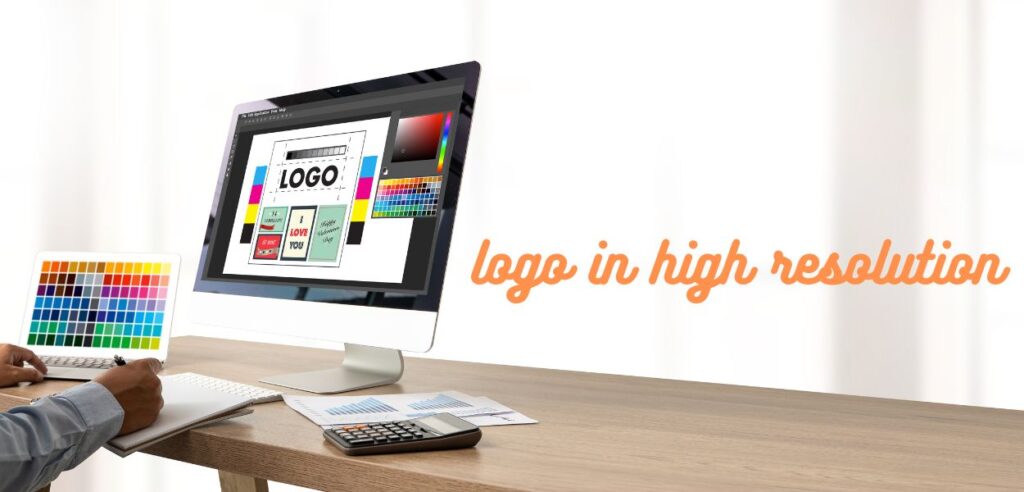
A high-resolution logo is a logo file with enough detail to look crisp wherever it is used, from a website header to a printed banner. For raster files such as PNG or JPG, print work typically calls for at least 300 pixels per inch (PPI) at the final size; the best master file, though, is a vector version (AI, EPS, SVG or PDF), which can be scaled to any size without losing quality.
Why Businesses Need a High-Resolution Logo
Your logo often creates a customer’s first impression, and it is the symbol people use to identify your brand. Because it carries the message of your products and services, it has to be clearly visible and sharp everywhere it appears. Logo Design Dallas designs high-resolution logos for businesses in every industry, with no upfront charge.
What Is Resolution for a Logo?
A high-resolution logo is a digital version of a brand’s identity packed with a large number of pixels per inch, producing a crisp, detailed image. In practice, “high resolution” usually means a minimum of 300 PPI, a widely accepted benchmark for print jobs that need quality output.
Pixels, PPI and DPI explained
- Pixels are the tiny squares that make up a digital image, stacked in rows. When you zoom in too far on a raster image, those squares are what you see as blur.
- Resolution on screens refers to the number of pixels displayed, described as width by height.
- PPI (pixels per inch) is used for screens and digital images.
- DPI (dots per inch) is used for print production. The higher the DPI, the more detail in the printed result.
- The two terms are often used interchangeably, which is why they are easy to mix up. In both cases, higher values mean more detail.
Raster vs. vector files
Bitmap (raster) formats such as JPEG, PNG, GIF and PSD have a fixed number of pixels, so they can only be enlarged so far before they blur. Vector files are built from paths rather than pixels and scale cleanly to any size. That is why a vector master is the safest foundation for a high-resolution logo. Our guide to logo file formats explains which file to use where.
How to Design a High-Resolution Logo in Adobe Illustrator
Designing a high-resolution logo in Adobe Illustrator involves several steps. Here is a basic guide:
- Define the concept. Decide what your logo should represent and what message it should communicate. Sketch rough ideas on paper before moving to the computer.
- Create a new document. A vector logo can be scaled to any size, but a workspace of around 1000 × 1000 px at 300 DPI is a comfortable starting point.
- Begin designing. Useful tools include the Pen Tool (P) for lines and curves, the Shape Tools for rectangles, circles and polygons, the Direct Selection Tool (A) for adjusting individual points, and the Pathfinder panel for combining shapes. Put different elements on separate layers so they are easier to edit.
- Choose your colors. Use the color picker, or enter exact values if you already have a brand palette.
- Add text. Use the Type Tool (T), then adjust font, size and color in the Character and Paragraph panels.
- Refine the logo. Tweak shapes, colors and positioning until everything is balanced.
- Save and export. Use File > Save As to keep an AI file for future edits, and export SVG for the web plus high-resolution PNG or JPG versions.
Creating a great logo takes time and practice, so don’t be discouraged if early attempts aren’t perfect.
Why High-Resolution Logos Matter for Branding
A company’s logo is the face of the business. For it to leave a lasting mark, it needs to be high resolution.
- Professionalism and trust: a sharp logo signals attention to detail, while a pixelated one can suggest carelessness and damage your reputation.
- Adaptability: high-resolution and vector logos can be resized for billboards, business cards, packaging and digital ads without losing quality.
- Consistency across platforms: your logo stays sharp on websites, social media, online ads and presentations, including high-definition screens.
- Future-proofing: as screens and printers improve, a high-quality master file keeps your brand looking its best.
Perception is power
Every part of a brand, from the logo to customer service, shapes how people perceive it, and that perception influences a business’s success. Because the logo is often the first point of contact, its quality plays a big part in forming a positive impression.
Why Print Needs a High-Resolution Logo
- Detail: more pixels per inch means a sharper, cleaner printed logo.
- Large formats: banners, posters and billboards need a logo that can be enlarged without blurring.
- Uniformity: the logo looks the same on everything from business cards to large banners.
- First impressions: printed materials are often a prospect’s first contact with your business.
High-Resolution Logo Files From Logo Design Dallas
Logo Design Dallas draws every logo from scratch in Adobe Illustrator and delivers final files in JPG, PNG, AI, EPS, PSD and PDF, with SVG on request, so you have the right high-resolution version for every use. If you only have a low-resolution or pixelated logo today, our vector logo conversion service can rebuild it as a clean, scalable file. Call (214) 329-9133 to get started.
Frequently Asked Questions
What resolution should a logo be for print?
Raster logo files for print are commonly prepared at 300 PPI or more at the final printed size. A vector file (AI, EPS, SVG or PDF) is even better because it scales to any size.
What is the difference between DPI and PPI?
PPI (pixels per inch) describes digital images and screens, while DPI (dots per inch) describes printed output. The terms are often used interchangeably, and higher values mean more detail.
Why does my logo look blurry when enlarged?
Raster formats like JPG and PNG have a fixed number of pixels, so enlarging them past their size makes the pixels visible. A vector version avoids this.
Which file formats does Logo Design Dallas deliver?
Final files are delivered in JPG, PNG, AI, EPS, PSD and PDF, with SVG available on request.